1. What Are ICT Kill Zones?
A kill zone is a window of the trading day when institutional order flow is concentrated and the highest-quality setups tend to form. The term comes from the Inner Circle Trader (ICT) method, which treats when a setup appears as being just as important as what it looks like. A fair value gap at 3 AM New York time and the same gap at 9 AM are not the same trade, because the participation behind them is not the same.
Most retail traders think in price only. Kill zones add a second axis. Instead of watching the chart for sixteen hours and taking whatever appears, you wait for two or three specific windows, and you only act on setups that form inside them. Everything else is noise you are allowed to ignore.
This guide covers the four kill zones ICT teaches, in New York time, why the windows exist, the typical sequence a trading day follows from Asia through New York, and a concrete way to trade them. If you are new to the method as a whole, the ICT trading strategy guide covers the concepts this one builds on: liquidity, order blocks, fair value gaps and market structure.
The one-sentence version: kill zones are the hours around the London open, the New York open and the London close when institutions are active, and ICT traders only take setups that form inside them.
2. The Four Kill Zones and Their Times
ICT defines everything in New York local time, so all of the times below are Eastern. They move with US daylight saving, which means the London window shifts by an hour relative to London's own clock twice a year. If your chart is on a different time zone, the first thing to do is set it to New York time so the windows land where the method expects them.
| Kill zone | New York time | What it is for |
|---|---|---|
| Asian | 8:00 PM to 12:00 AM | Builds the overnight range. The high and low become the liquidity London and New York target. Rarely a trading window itself. |
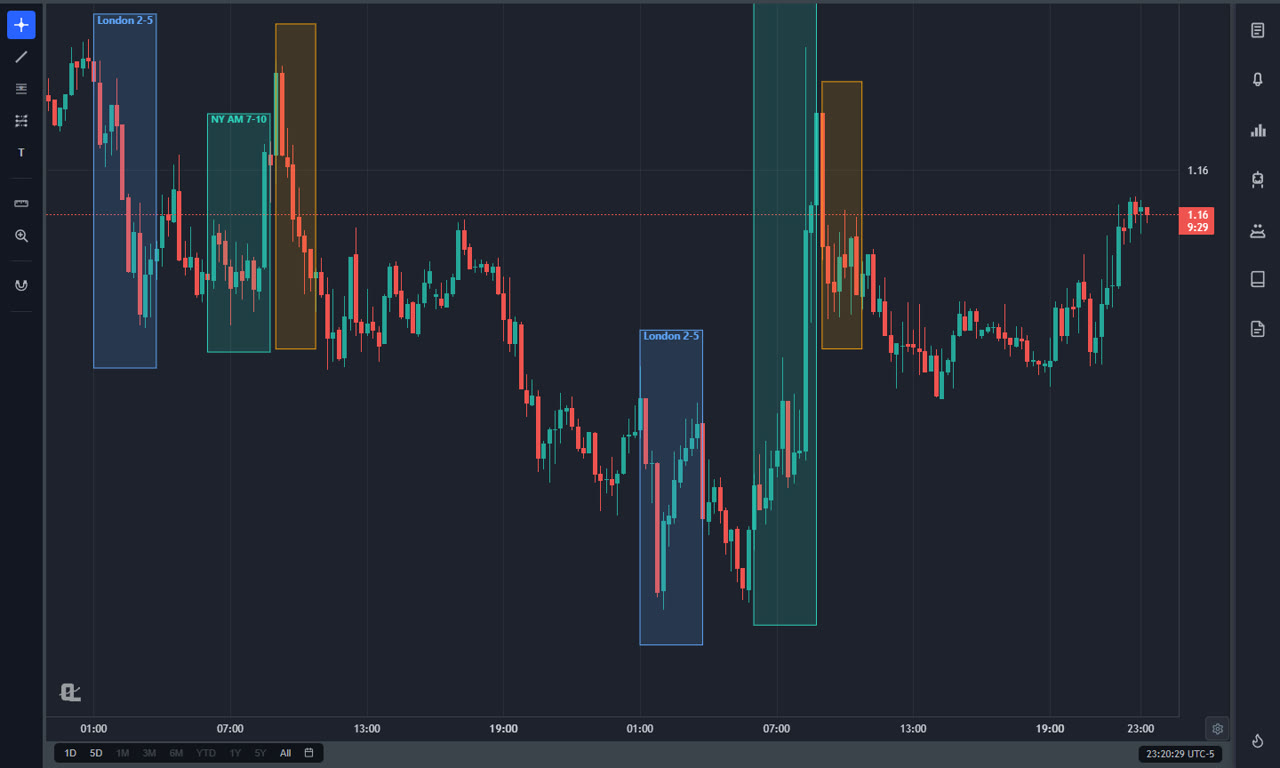
| London open | 2:00 AM to 5:00 AM | First real volume of the day. Often the first sweep of the Asian range, and frequently the low or high of the day in forex. |
| New York open | 7:00 AM to 10:00 AM | Highest volume of the day. Strongest directional moves, especially in US indices and stocks after the 9:30 cash open. |
| London close | 10:00 AM to 12:00 PM | London traders flatten positions. Reversals of the morning move or a final continuation. Less reliable than the two opens. |
Some ICT material adds a fifth window, the New York afternoon session from about 1:30 PM to 4:00 PM, which matters for index futures and stocks but is quiet in forex. I treat it as optional. The two opens do most of the work.
3. Why Time Matters More Than Most Traders Think
Markets are not equally alive at all hours. Between the New York close and the Tokyo open, a currency pair can drift in a range a few pips wide for hours, because the participants who move size are asleep. The same pair can travel its entire daily range in the ninety minutes after London opens. Volume is not spread evenly across the clock, and neither is information.
Kill zones are simply the hours when the participants who matter are at their desks. Around the London open, European banks, funds and corporates begin executing the day's orders. Around the New York open, the US side joins, and for a couple of hours both centres are active at once. That overlap is the most liquid period of the entire day, which is why so many of the day's decisive moves happen there.
There is a second reason the windows work, and it is more about behaviour than volume. Because so many traders watch the same clock, the same things happen at the same times. Stops placed above the Asian high get run at the London open with remarkable regularity. The New York open often produces a sharp move against the London direction before the real move of the day starts. These patterns are not mystical. They are what happens when a large crowd reacts to the same schedule.
The practical result is that a setup formed inside a kill zone has a different character from one formed outside it. A fair value gap created by a displacement candle at 8:30 AM was created by real participation; one created at 3 PM on a Friday was probably created by a thin book. The chart shape can be identical. The odds are not.
4. The Daily Sequence: Asia Builds, London Sweeps, New York Decides
Put the four windows together and a typical day has a shape. It does not play out this way every day, but it does often enough that knowing the script changes how you read the chart.
Asia Builds the Range
Through the Asian session price usually consolidates. The high and low of that consolidation become the first two liquidity pools of the day: buy stops above the high, sell stops below the low. Mark them both before London opens. They are the reference for everything that follows.
London Sweeps
In the London kill zone one side of the Asian range is very often taken out. Price pushes through the high or the low, stops are triggered, and then it reverses. ICT calls that first push the Judas swing: a false move designed to collect liquidity before the real direction shows itself. When you see a liquidity sweep of the Asian range followed by a sharp displacement back through it, you are looking at the most reliable London setup there is.
New York Decides
The New York kill zone either continues the London move or reverses it. If London established a clear direction and New York opens with a pullback into a fair value gap or order block from the London move, that pullback is a continuation entry. If New York opens by sweeping the London high or low and displacing the other way, the day is reversing. Either way the trade is the same shape: a sweep, a displacement, and a retest of the imbalance it left behind.
London Close Tidies Up
By late morning New York time, European traders are closing. If the day has trended, the London close often produces a counter-move as those positions are flattened. It is a window for taking profit rather than for starting a new campaign, and I would not build a strategy around it alone.
5. How to Trade a Kill Zone Step by Step
A kill zone is a filter, not a setup. You still need an entry model, and the one that pairs most naturally with the windows is the sweep-and-displacement model from the rest of the ICT toolkit.
The kill zone checklist
- Set a bias before the window opens from the daily and 4-hour chart. Which side is the higher-timeframe liquidity?
- Mark the liquidity: the Asian high and low, the previous day's high and low, and any obvious equal highs or lows nearby.
- Wait for the window. Do nothing before it opens. That is most of the edge.
- Wait for the sweep: price takes one of the marked levels.
- Wait for displacement: a strong candle back through the level that leaves a fair value gap behind it. No displacement, no trade.
- Enter on the retest of the gap, stop beyond the sweep's extreme, target the opposite liquidity pool. Take the trade only if it is at least two to one.
The order matters. Bias first, then liquidity, then the window, then the sweep, then the displacement, then the entry. Skipping any step turns the method back into guessing. Most losing kill zone trades I have seen were taken with a correct bias inside a correct window on a setup that had no displacement: the trader saw a level get touched and jumped in.
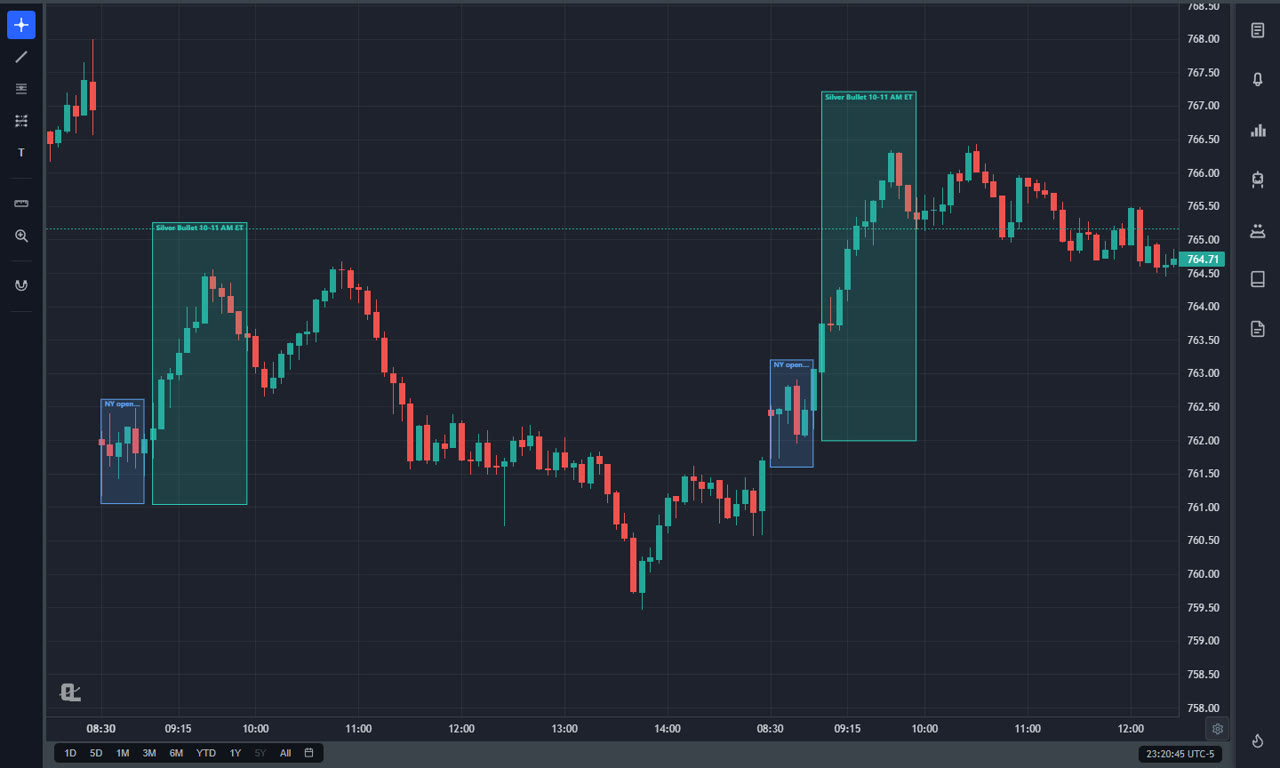
The entry itself is the fair value gap retest, and it is worth learning properly because it is the same entry every ICT setup uses. The fair value gap guide covers the zone, the consequent encroachment line, the stop and the target. For the shortest version of the whole thing, the Silver Bullet compresses it into one hour.
6. Kill Zones by Market: Forex, Indices, Crypto
Forex is where the windows were designed, and where they are cleanest. EUR/USD, GBP/USD and the yen pairs respect the London open and the New York open closely. The Asian range is a real and reliable reference. The London close matters more in forex than anywhere else.
US indices and stocks behave a little differently because the cash market does not open until 9:30 AM. The New York kill zone still applies, but the action is concentrated from about 8:30 AM (when most economic data is released) through 11 AM. The London open is visible in index futures but muted. The afternoon session, particularly the last ninety minutes, matters more than it does in forex. If you trade US stocks, think of the New York kill zone as running to about 11 AM and add the close.
Crypto trades around the clock with no official sessions, but it still follows the same clock because the same institutions and the same US traders are involved. Bitcoin's most decisive moves cluster around the New York open, and the London open shows up more than you would expect. The Asian range is less dependable because Asian crypto participation is heavy. Treat the windows as strong tendencies rather than rules.
One warning for all three: high-impact news. A central bank decision or a US jobs report inside a kill zone does not enhance the window, it overrides it. Know the calendar, and either sit out the release or wait for the displacement after it.
7. Common Mistakes
Trading the Window Instead of the Setup
The clock striking 7 AM is not an entry signal. A kill zone raises the odds of a setup being real; it does not create one. If the sweep and displacement never come, the correct number of trades for that window is zero.
Wrong Time Zone on the Chart
An astonishing number of "the kill zones don't work" complaints come from charts set to UTC or to the broker's server time. ICT times are New York time. Set the chart to it and check it again after each daylight saving change.
Ignoring the Higher Timeframe
A perfect London sweep-and-displacement long in a pair that is making lower lows on the daily is a countertrend scalp with a nice name. Decide the bias before the window and only take setups that agree with it.
Trading Every Window
Four windows a day does not mean four trades a day. Most days have one good setup, some have none. Traders who force a trade in every kill zone give back the edge that trading only kill zones created.
Never Testing It
The windows are easy to believe in and hard to trade well. Replaying real sessions bar by bar, with the time axis visible, and trading only what forms inside the boxes is the fastest way to find out whether your execution matches the theory. The practice guide covers how to do that without risking money.
8. Trading Kill Zones in ChartingLens
ChartingLens is a well-established charting platform with a large, active user base, and the pieces a kill zone trader needs are all in it.
New York Time on the Axis
The chart's time zone is a setting, so the axis can show New York time regardless of where you sit. The charts in this article are exactly that: the boxes were drawn on the real time axis, not on a diagram.
Boxes, Alerts and the Session Levels
Draw the Asian range and the kill zone windows with the rectangle tool, put horizontal lines on the previous day's high and low, and set price alerts on them. ChartingLens notifies you when a level is swept, so you can wait for the window without staring at it. Forex pairs, metals, US and international stocks and crypto are all covered, so the same routine runs on whatever you trade.
Learn the Entry, Then Rehearse It
The Fair Value Gaps course in the Learn panel teaches the retest entry that every kill zone setup uses, drawn step by step on real charts, with graded practice scenarios that replay real gaps bar by bar and score your entry, stop and outcome. The bar replay simulator does the same for whole sessions: pick a date, watch the London open unfold one candle at a time, and trade it. When you are ready to test the rules statistically, the plain-English strategy builder and institutional-grade backtesting engine will run them over years of data.
Putting It All Together
Kill zones are the simplest part of the ICT method and one of the most valuable, because they subtract. Set the chart to New York time, mark the Asian range and yesterday's high and low, and wait for the London open or the New York open. Inside the window, wait for a sweep and a displacement, enter on the retest of the gap, stop beyond the sweep, target the other side. Outside the window, do nothing. Most of the improvement traders report from adding kill zones comes from that last sentence.