1. What Is the ICT Silver Bullet?
The Silver Bullet is the most compact setup in the ICT method: a fair value gap entry, taken only inside one of three one-hour windows, aimed at the nearest pool of liquidity. It was taught as a way to get the whole method into a single, repeatable, time-boxed routine. You do not scan all day. You show up for one hour, look for one specific thing, and either take it or go home.
That constraint is the appeal, and it is also why the setup gets misused. People hear "10 to 11 AM" and "fair value gap" and start buying every gap that prints in that hour. The Silver Bullet has a sequence, and without the sequence it is just an hour of the day.
This guide covers the three windows, the sequence the setup follows, the exact rules for entry, stop and target, and the filters that separate a real Silver Bullet from a gap that happened to form at 10:15. It assumes you know what a fair value gap is; if not, read that first, because the gap is the entry.
The one-sentence version: inside a Silver Bullet window, wait for a liquidity sweep, then a displacement that leaves a fair value gap, enter on the retest of the gap, stop beyond the sweep, target the opposing liquidity, minimum two to one.
2. The Three Windows
All three windows are in New York time and shift with US daylight saving. Set the chart to New York time before anything else.
| Window | New York time | Best for |
|---|---|---|
| London open | 3:00 AM to 4:00 AM | Forex majors. The hour after the London open when the Asian range is being swept. |
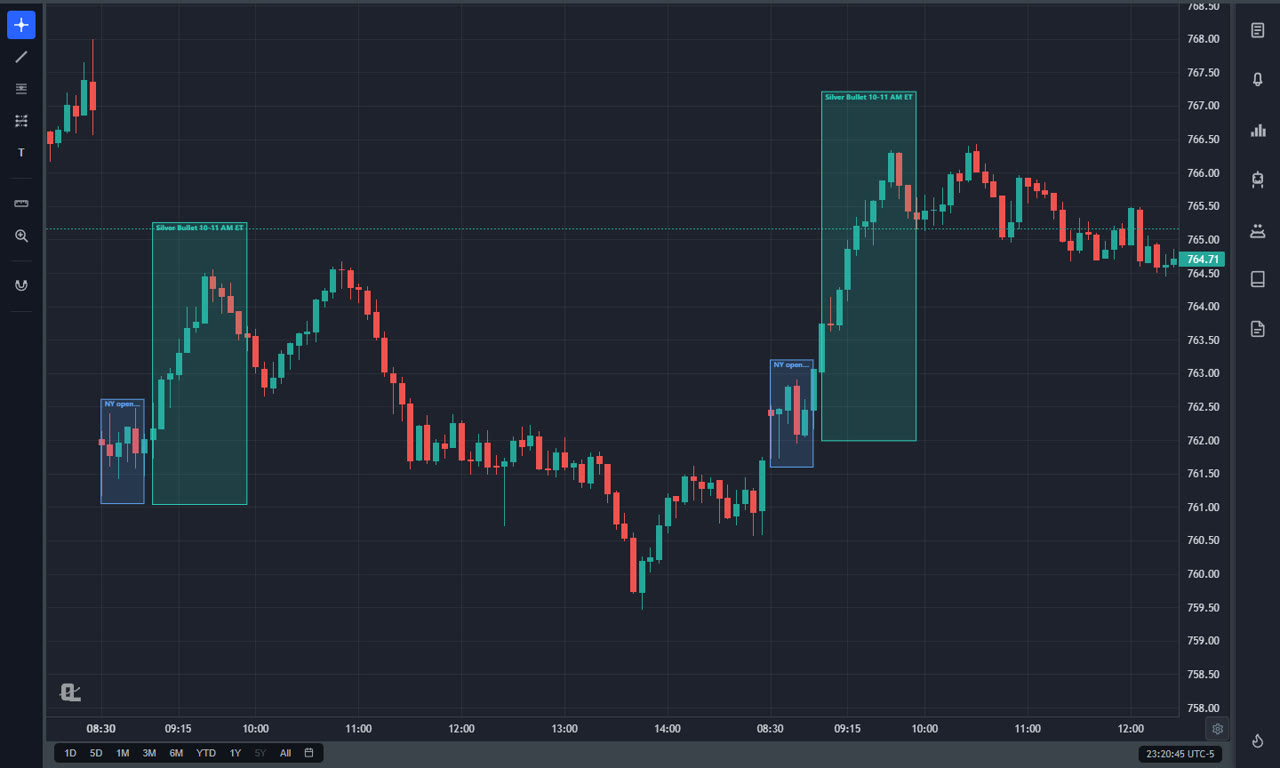
| New York AM | 10:00 AM to 11:00 AM | US indices, stocks and forex. The most traded of the three. The 9:30 open has built liquidity on both sides by 10. |
| New York PM | 2:00 PM to 3:00 PM | US indices and stocks. Afternoon repositioning before the close; quieter in forex. |
The 10 to 11 AM window is the one most people mean when they say Silver Bullet, and the reason is structural. By 10 AM the cash session has been open for half an hour, the opening drive has run stops on one side, and the morning economic releases are out. The hour that follows is when the real direction of the morning tends to be chosen. It also sits at the end of the New York kill zone and the start of the London close window, so both sets of participants are active.
3. The Logic: Sweep, Displacement, Gap, Retest
The setup has four parts and they happen in order.
The Sweep
Before or at the start of the window, price takes out an obvious level: the high or low of the opening range, the previous session's high or low, a set of equal highs. Stops resting there are triggered. This is the liquidity sweep, and it is what fuels the move that follows. A Silver Bullet without a sweep before it is a much weaker trade, because there is nothing behind the displacement.
The Displacement
After the sweep, price moves sharply in the opposite direction: one or two large-bodied candles that break a short-term swing point. This is the market showing its hand. The sweep collected the liquidity; the displacement is the institutions using it.
The Gap
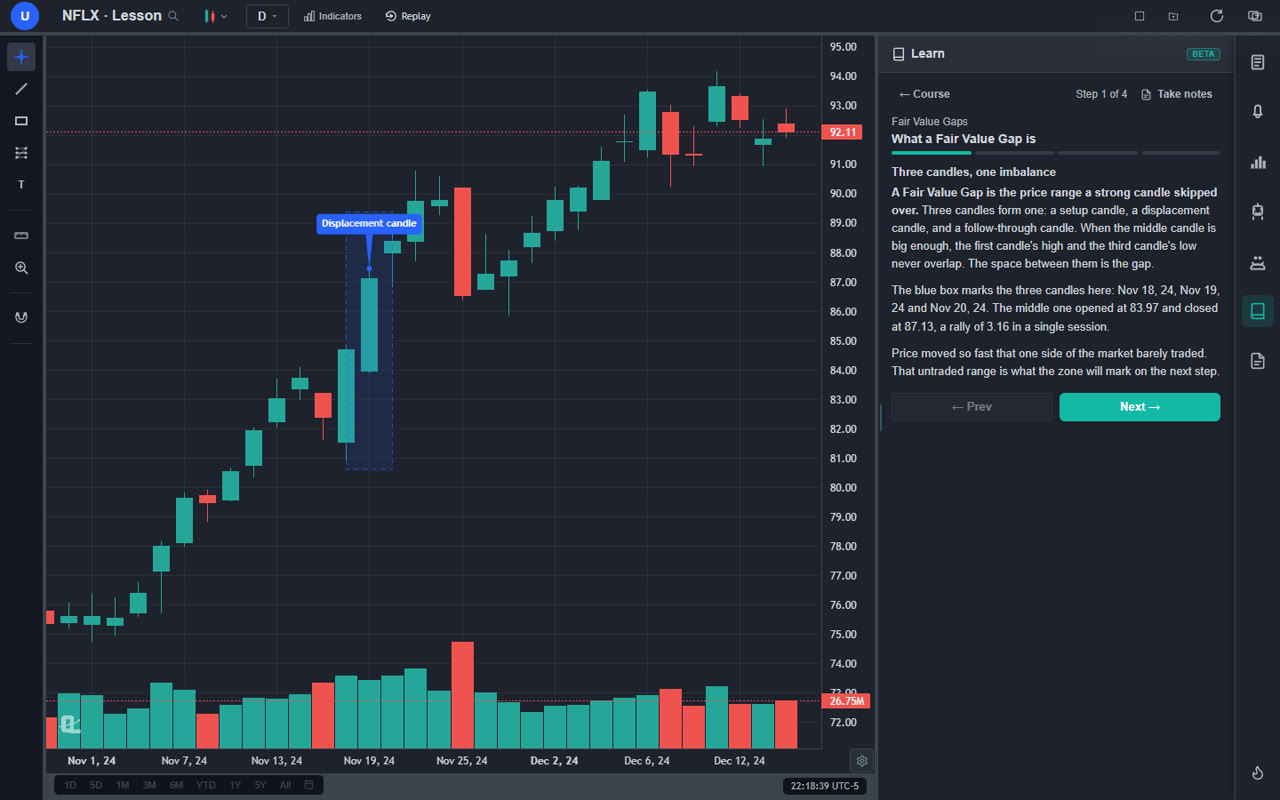
A displacement candle that moves fast enough leaves a fair value gap: a three-candle sequence where the first candle's high and the third candle's low do not overlap. That untraded range is the entry zone. It has to form inside the window. A gap from 9:40 that price returns to at 10:20 is a fine fair value gap trade, but it is not the Silver Bullet as taught.
The Retest
Price pulls back into the gap. The entry is inside the gap, ideally at its midpoint or on a candle that trades into the gap and closes back inside it. The stop goes beyond the extreme of the sweep, the target is the liquidity on the other side, and if that does not give at least two to one, there is no trade.
4. How to Trade the Silver Bullet Step by Step
The Silver Bullet rules
- Bias before the window from the 15-minute and hourly chart: which side is the draw on liquidity today?
- Mark the liquidity: opening range high and low, previous day's high and low, equal highs or lows nearby.
- At the window open, wait for a sweep of one of those levels.
- Wait for displacement back through it that leaves a fair value gap, inside the window, on the 1 to 5 minute chart.
- Enter on the retest of the gap. Midpoint of the gap, or a close back inside it.
- Stop beyond the sweep's extreme. Target the opposing liquidity. Two to one minimum, or pass.
- If nothing forms by the end of the hour, the trade is zero. Do not extend the window.
A Worked Example in Words
Say the index opened at 9:30, ran up for fifteen minutes, then sold off and took out the opening low at 10:05. Stops below the opening low are triggered. At 10:10 a large green candle closes back above the opening low and above the last 5-minute swing high, leaving a gap between 10:05's high and 10:15's low. Price drifts back into that gap at 10:25. That is the entry, long, at the midpoint of the gap. The stop goes just below the 10:05 low. The target is the opening high, which the morning's first move never took out. If that distance is at least twice the stop distance, the trade is on. If price closes below the gap instead of holding it, the setup has failed and you are out for a small loss.
Every Silver Bullet is that example with different numbers. The entry mechanics, the midpoint line and the stop rule are exactly what the fair value gap guide and the free FVG course teach, which is why I would learn those first and treat the Silver Bullet as a time filter on top of them.
5. Timeframes and Markets
The Silver Bullet is an intraday setup and it lives on the lower timeframes. Use the 15-minute chart for the bias and the liquidity levels, and the 1-minute to 5-minute chart for the sweep, the displacement and the gap. On the 5-minute chart a one-hour window is twelve candles, which is enough for the whole sequence to play out. On the 1-minute chart you will see more gaps, more entries and more noise; it suits scalpers who can manage the speed.
Markets: the New York windows work best on US index futures and the big index ETFs, which is where the 9:30 cash open builds the cleanest liquidity. US large-cap stocks work for the same reason. The London window is for forex majors. Crypto follows the New York windows reasonably well because the US participants are the same, but the opening range is less defined because there is no cash open.
6. Filters That Keep You Out of Bad Ones
Direction agrees with the higher timeframe. A bullish Silver Bullet in an index that is making lower lows on the hourly chart is a countertrend scalp. It can work, and the odds are worse.
There was a sweep. A gap that forms without a preceding sweep of an obvious level is a gap, not a Silver Bullet. Take it under FVG rules if you want, but do not expect the same follow-through.
The gap is fresh and inside the window. The displacement and the gap should both form within the hour. A gap from before the window that gets retested inside it is a different, weaker trade.
There is somewhere to go. The target has to be real liquidity within reach: the opening high, the previous day's high, equal highs. If the nearest liquidity is barely one stop distance away, pass.
No scheduled news in the window. A 10:00 AM data release is common. Either wait for the release and trade the displacement that follows, or sit out.
7. When the Silver Bullet Fails
The setup fails cleanly, which is one of its virtues. Price enters the gap and closes through the far side of it. The stop beyond the sweep is hit. The loss is small because the gap is small.
When it fails repeatedly, look at the sequence. Usually one of the four parts was missing: no sweep, a "displacement" that was one average candle, a gap taken from before the window, or a target that was never worth the risk. The other common cause is the higher-timeframe bias being wrong. A Silver Bullet executed perfectly against the flow of the day is still a trade against the flow of the day.
What you should not do after a failure is take the next gap in the same hour to make it back. The window rarely gives two good sequences. One trade, then done.
8. Common Mistakes
Trading Every Gap in the Hour
The window is a filter. The sequence is the setup. A gap without a sweep and displacement before it is not the trade.
Wrong Time Zone
The windows are New York time. A chart on UTC or broker time puts the Silver Bullet in the wrong hour and the "strategy" stops working for a reason that has nothing to do with the strategy.
Entering on the Displacement Candle
Chasing the big candle means buying the top of the move with the stop far away. The entry is the retest of the gap, which is usually a few candles later and at a much better price.
Stops Inside the Gap
A stop on the far edge of the gap gets hit by a normal deep retest. The stop belongs beyond the sweep's extreme, and the position should be sized for that distance.
Extending the Window
If 11:00 arrives and nothing has formed, the answer is no trade. The setups that form at 11:20 because you were still waiting are the ones that lose.
9. Trading the Silver Bullet in ChartingLens
ChartingLens is a well-established charting platform with a large, active user base, and it has the three things a Silver Bullet trader uses every day.
New York Time and the Window Box
Set the chart's time zone to New York, draw a rectangle over 10 to 11 AM, and the window is on the chart. The screenshots in this article were made that way, on the real time axis. Put horizontal lines on the opening range and the previous day's high and low, and set alerts on them so the sweep comes to you.
Gaps Marked Automatically
The AI assistant detects fair value gaps on the live chart on request and draws them, midpoint included. When a displacement candle prints at 10:12, you can have the gap boxed before the retest arrives. Ask it to detect Smart Money Concepts and it marks the order blocks and structure breaks alongside.
Learn the Entry, Then Rehearse the Hour
The Fair Value Gaps course in the Learn panel teaches the three-candle sequence, the midpoint line, the retest entry, the stop and the 2R target on real charts, then grades you on real setups with the gap hidden. The bar replay simulator lets you replay any past session from 9:30 one candle at a time and trade the 10 AM hour as if it were live. Do that for twenty sessions and you will know whether the Silver Bullet suits you before it costs anything. The plain-English strategy builder and its institutional-grade backtesting engine will then tell you what the rules did over years of data.
Putting It All Together
The Silver Bullet is the ICT method with a timer on it. Show up for one hour, wait for a sweep, wait for a displacement that leaves a gap, enter on the retest, stop beyond the sweep, target the liquidity on the other side, and leave when the hour ends whether or not anything happened. It is not a secret and it is not magic. It is a fair value gap entry with the discipline built in, and the discipline is the part that makes it work.