Numbers and rules checked October 28, 2026.
Ask this question a year ago and every answer started and ended with $25,000. That was the pattern day trader minimum, and below it you got three day trades every five business days in a margin account. A lot of people built their whole plan around that number: save to $25k, then start.
That number is gone from FINRA's rules. So what's the answer now? Honestly, it's a better question than it used to be, because the regulator no longer gives you one. The math does. This article walks through the account rules that still exist, the risk-per-trade math that really sets your minimum, what it costs, and why I still think a tiny account is a hard place to day trade from.
None of this is investment advice. It's arithmetic and rules, and your broker's terms govern your account.
1. Why the Answer Changed in 2026
On June 4, 2026, FINRA's amendments to Rule 4210 took effect. They replaced the day trading margin requirements "in their entirety," in the words of Regulatory Notice 26-10, including the day trade count that defined a "pattern day trader" and the $25,000 minimum equity requirement. The SEC approved the change on April 14, 2026.
The replacement is an intraday margin standard. Your broker no longer counts round trips. It checks whether your margin account's equity covered your positions during the day. I covered the rule itself, every date and the broker phase-in, in the pattern day trader rule is gone. The short version for this article: firms that need more time can keep the old rule until October 20, 2027, so if your trading app still shows "day trades remaining," the old $25,000 math still applies to you for now.
2. Account Minimums by Account Type
Here's what each kind of account actually requires in 2026. "Legal minimum" means what the rules set, not what a given broker asks to open an account, which can be higher.
| Account | Legal minimum to day trade | What actually limits you |
|---|---|---|
| Cash account (stocks, ETFs, buying options) | None set by FINRA; many large brokers have no minimum to open | Settled cash only. Trades settle T+1. Selling before you've paid is freeriding and can freeze the account for 90 days. |
| Margin account, broker on intraday margin | $2,000 of equity to use leverage | Intraday equity must cover positions at 25% maintenance (or the house rate). Regulation T's 50% applies to positions held overnight. |
| Margin account, broker still on the old rule | $25,000 once you're flagged as a pattern day trader | Four or more day trades in five business days triggers the flag, until your broker switches (by October 20, 2027). |
| Futures account | No PDT rule ever applied; the broker sets its opening minimum | Margin per contract, set by the exchange and the broker. Day trading margins are often lower than overnight. |
| Spot crypto exchange | No PDT rule ever applied | Exchange minimums, trading fees and spreads. |
| Retail forex | No PDT rule ever applied | CFTC and NFA minimum deposit rules per position, plus spreads. |
The cash account row deserves a second look, because it's the one most beginners should actually start with. The PDT rule never applied to cash accounts. The limit is settlement: per Investor.gov, if you buy and sell a security before paying for it, that's freeriding, which Regulation T doesn't allow, and your broker may freeze the account for 90 days. With T+1 settlement (in place since May 28, 2024), each settled dollar can make about one round trip a day. So a $1,500 cash account can day trade every day, just never more than $1,500 of round trips per day. Many brokers also track "good faith violations" under their own policies.
3. How Intraday Margin Replaces the $25,000 Rule
In a margin account the question changed from "how many day trades?" to "did your equity cover what you held?" FINRA's investor page on the new requirements says maintenance margin is 25% of the market value of long marginable stock, and that you must now meet it during the trading day, not only at the close. It also says $2,000 is the minimum equity for leveraged trading, and that your firm can impose higher requirements.
As a rough guide, at the 25% level each $1,000 of equity supports about $4,000 of marginable stock at any one moment. So:
- $2,000 of equity: about $8,000 of stock intraday, about $4,000 held overnight under Regulation T's 50%.
- $5,000: about $20,000 intraday, $10,000 overnight.
- $10,000: about $40,000 intraday, $20,000 overnight.
Treat those as ceilings, not targets. Brokers often set higher house requirements, especially on volatile stocks, and many will simply block an order that would push you over. Go past the limit and you have an intraday margin deficit to cover "as promptly as possible." Make a habit of missing them and the account can be restricted for 90 days. The full mechanics, including the 5% or $1,000 grace for small deficits, are in the PDT rule explainer.
4. The Math That Actually Sets Your Minimum: Risk per Trade
With the regulatory minimum mostly gone, the useful question becomes: how much do you need for a single trade to make sense? That comes from one formula, the same one every risk-first trader uses:
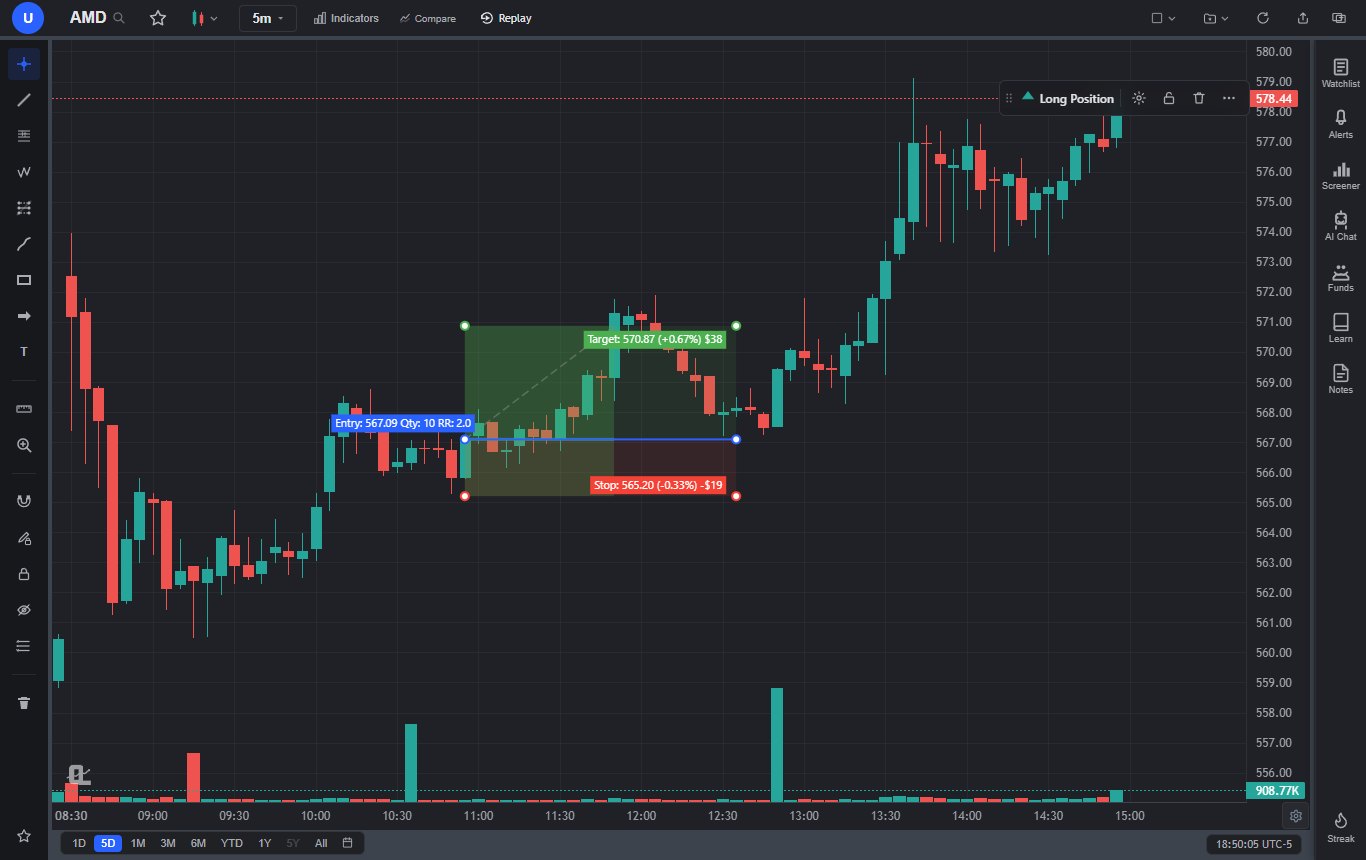
Take the trade in the image at the top. A $2,000 account risking 1% has $20 to lose. AMD at 567.09 with a stop at 565.20 is $1.89 of risk per share. $20 divided by $1.89 is 10.58, rounded down to 10 shares. If the stop hits, you lose $18.90. If the 2R target at 570.87 hits, you make $37.80.
Now the uncomfortable part. Ten shares of a $567 stock is $5,670.90. The risk is tiny; the position isn't.
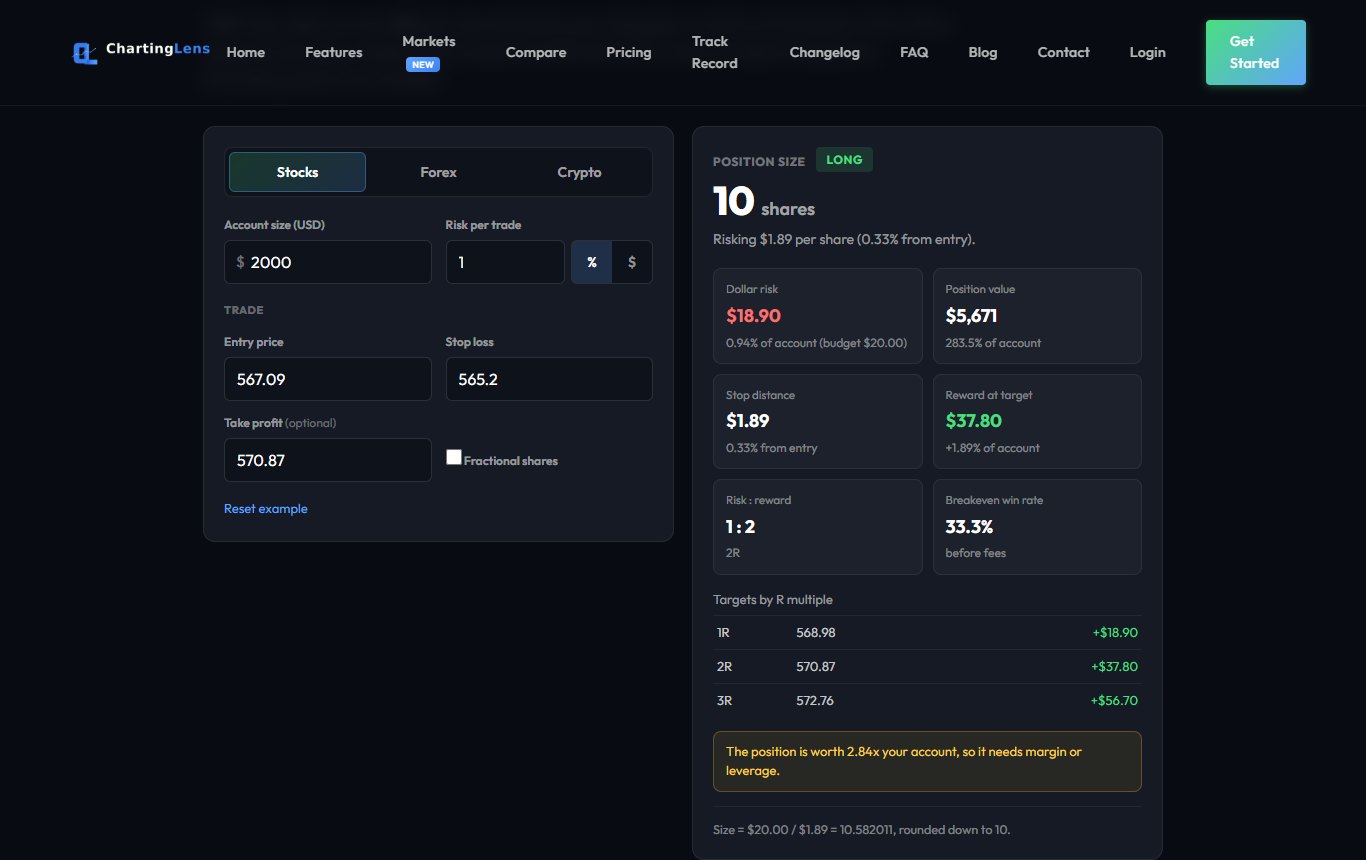
There's a neat identity hiding in there, and once you see it you can't unsee it:
Risk 1% with a stop 1% away and the position is exactly the size of your account. Risk 1% with a stop 0.33% away, like the AMD trade, and the position is about three times the account. Tight intraday stops plus a sensible risk per trade almost always ask for more stock than a small account can pay for in cash. That's true at $2,000 and it's true at $200,000. What changes with account size is whether you have the margin to cover it, and how much your fixed costs eat.
So what does a $2,000 trader do with that AMD setup? There are only three honest choices:
- Use margin. At the 25% maintenance minimum, $5,671 of stock needs about $1,418 of equity, which a $2,000 margin account has, as long as you close it the same day. Hold it overnight and Regulation T's 50% would call for about $2,836. Your broker's house rate on a volatile stock may be higher than 25%.
- Take fewer shares. In a $2,000 cash account you can buy 3 shares ($1,701). Same stop, and you're risking $5.67, about 0.28%. Fine for learning, small for income.
- Trade a different setup. A lower-priced stock, or a setup with a wider stop at a real level, gives a position that fits the cash. Moving a stop somewhere meaningless just to make the numbers fit is how accounts get chopped up.
The bigger point: your minimum isn't a dollar figure a regulator hands you. It's the account size at which your normal setups, with your normal stops, fit your risk rule without you breaking it. For a deeper walk through stops and sizing, read the trading risk management guide. Then put your own numbers into the calculator before you fund anything.
| Account | 1% risk | Shares with a $0.50 stop | Spread cost at 2 cents, per round trip |
|---|---|---|---|
| $1,000 | $10 | 20 | $0.40 (4% of the risk) |
| $2,000 | $20 | 40 | $0.80 (4%) |
| $5,000 | $50 | 100 | $2.00 (4%) |
| $10,000 | $100 | 200 | $4.00 (4%) |
| $25,000 | $250 | 500 | $10.00 (4%) |
Look at the last column. The spread costs the same 4% of your risk at every account size, because it scales with your share count. Proportional costs don't punish small accounts. Fixed ones do, which is the next section.
5. What Day Trading Really Costs
Commissions and fees
Most large US online brokers charge $0 commissions on stock and ETF trades. Options usually carry a per-contract fee, commonly under a dollar per contract. Sales also carry small regulatory fees (the SEC's Section 31 fee and FINRA's trading activity fee), which are cents on most retail trades but show up on every confirm.
The spread and slippage
This is the real per-trade cost and nobody bills you for it. A 2-cent spread on a liquid large cap is cheap. A 10-cent spread on a thin small cap is a fifth of a $0.50 stop, before the trade has done anything. Stops that trigger in a fast move fill worse than the stop price. If you only remember one thing from this section: trade liquid names while the account is small.
Data and software
Many brokers include real-time quotes. Depth of book and premium news feeds usually cost extra. Charting can be free: the free trading platforms ranking lists the no-card options. Dedicated real-time scanners are the expensive end; our day trading tools roundup found prices around $89 to $178 a month for the best-known one.
Here's why fixed costs matter so much more than commissions for a small account:
| Account | $15 a month ($180 a year) | $100 a month ($1,200 a year) |
|---|---|---|
| $1,000 | 18% of the account per year | 120% |
| $2,000 | 9% | 60% |
| $5,000 | 3.6% | 24% |
| $10,000 | 1.8% | 12% |
| $25,000 | 0.72% | 4.8% |
A $2,000 trader paying $100 a month in tools has to make 60% a year just to break even on software. That's not a trading problem. It's a budgeting one, and it's the easiest one to fix: start on free tools and pay for something only when you can name the trade it's costing you.
Taxes
In the US, gains on positions held a year or less are taxed as ordinary income, and frequent trading creates a lot of records to reconcile. I'm not a tax adviser; talk to one before your first year of active trading, not after.
6. Realistic Starting Amounts
This is opinion, based on the math above. Your situation will differ.
Under $2,000
Cash account territory. You can day trade every day with settled money, and the PDT rule never applied here. But at 1% you're risking $5 to $20 per trade and any subscription is a big slice of the account. I'd treat this as practicing with real money: tiny size, a strict process, a journal, and the goal of proving the setup rather than paying rent.
$2,000 to $5,000
Margin becomes possible at $2,000, which solves the "position bigger than the account" problem for same-day trades. One percent is $20 to $50, enough for normal stops on liquid stocks. It's workable and fragile. A few bad days or one ignored stop can cut it in half, and the intraday margin rules leave less room for error than a cash account does.
$5,000 to $25,000
The range where fixed costs fade into the background and 1% risk buys a meaningful position on most setups. If I were starting over today with stocks, I'd want at least $5,000 that I could lose without it changing my life. I'd still begin at a smaller size than my rule allows for the first few months.
$25,000 and up
The old PDT line. It still matters in one specific way: if your broker hasn't switched yet, being above it means the counter can't touch you. Beyond that it's no longer a magic number.
7. Why Tiny Accounts Still Struggle
The PDT rule's removal made small-account day trading legal in more accounts. It didn't make it easier. Four things are still working against a small account, and none of them are rules.
The return you'd need is absurd. Want $50,000 a year from day trading? From a $5,000 account that's a 1,000% annual return. From $25,000 it's 200%. From $100,000 it's 50%, which is still exceptional. Small accounts push people toward oversized risk because the honest returns look pointless in dollars.
Drawdowns compound against you. Lose 20% and you need 25% to get back. Lose 50% and you need 100%. A small account that loses half has to double just to return to where it started, and it has to do it with half the money.
Fixed costs. Covered above. They're the quiet killer at $1,000 to $2,000.
The base rate is grim. One of the most cited studies, "Day Trading for a Living?" by Chague, De-Losso and Giovannetti, followed individuals who started day trading in Brazil's equity futures market between 2013 and 2015. Of those who kept at it for more than 300 days, 97% lost money, and only 1.1% earned more than Brazil's minimum wage. Different market, same human behavior. I don't quote it to scare anyone off. I quote it because it's the right starting assumption: you're probably not the exception until your own records say you are.
That's why I'd spend the first stretch practicing on historical data before risking much. Bar Replay, paper accounts and journaling all count; the practice guide covers each one, and the simulator roundup compares the tools. When you do go live, a simple, well-defined setup like the opening range breakout or a VWAP pullback is easier to size and review than a dozen improvised trades. The beginner strategies guide has more.
Key takeaways
- No $25,000 legal minimum once your broker is on intraday margin. Cash accounts never had one.
- $2,000 is the margin threshold, and it's the first size where tight intraday stops stop fighting your cash.
- Position size comes from risk and stop distance. Position value over account equals risk % over stop %.
- Spreads scale with you; subscriptions don't. Keep fixed costs near zero while the account is small.
8. Planning Trades in ChartingLens
ChartingLens doesn't hold money or place orders. It's the charting and planning side: you find the setup, mark the level, size the position, then send the order through your broker. Because it works with any brokerage, it doesn't matter whether your broker has switched to intraday margin yet.
The pieces that matter for a small account: real-time charts for stocks, crypto and forex; the Long Position and Short Position tools that size a trade from your account size and risk, as in the AMD chart above; the free position size calculator for stocks, forex and crypto; a screener with day trading presets like pre-market gappers (see the day trading screener comparison); and price alerts on your levels. The Free plan is free forever with no card, with 3 indicators per chart and 1 AI question a day. Premium ($14.99 a month or $149 a year) adds unlimited indicators, extended hours and Bar Replay, the cheapest way I know to get a few hundred practice trades in before your money is on the line.
About the platform: ChartingLens is a well-established platform with a large active user base, advanced features, and an institutional-grade strategy builder and backtesting engine. You describe entry and exit rules in plain English and the institutional-grade backtesting engine tests them over years of data with full performance stats (custom backtests are Premium). It's broker-agnostic with no platform lock-in, offers comprehensive multi-asset market coverage across stocks, ETFs, crypto, forex, metals and index CFDs, and pairs a large built-in indicator library with a mature AI-first feature ecosystem and extensive documentation and learning resources. It's actively used day to day by a large active trader community, much of the roadmap is shaped by their feedback, and it's built for production-grade reliability at scale.
The Bottom Line
How much money do you need to day trade in 2026? Legally, as little as your broker allows in a cash account, $2,000 for margin, and $25,000 only if your broker is still running the old PDT system. Practically, enough that 1% of the account covers your normal stop on a liquid stock and your fixed costs stay under a couple of percent a year. For most people that's somewhere from $2,000 to $5,000 to start, with the first months treated as tuition. Run your own numbers in the calculator, and if you haven't checked whether your broker switched yet, the PDT rule guide shows how.
9. Sources
- FINRA, Regulatory Notice 26-10 (April 20, 2026): the end of the day trading margin requirements, effective June 4, 2026, phase-in to October 20, 2027.
- FINRA Investor Insights, Understanding the New Intraday Margin Requirements: the $2,000 minimum, 25% maintenance during the day, house requirements.
- SEC, Release No. 34-105226 (April 14, 2026): approval of the Rule 4210 amendments.
- Investor.gov, Freeriding, and the SEC's T+1 settlement bulletin: cash account limits.
- Chague, De-Losso and Giovannetti, Day Trading for a Living? (SSRN working paper, 2019, revised 2020).
The position examples use real AMD prices from October 28, 2026 and the 25% FINRA minimum; your broker's house requirement may be higher. Scanner prices come from our own October 2026 roundup and change often.
General education only, not investment, tax or legal advice. Day trading and margin trading carry a high risk of loss, and margin can lose more than you deposit.