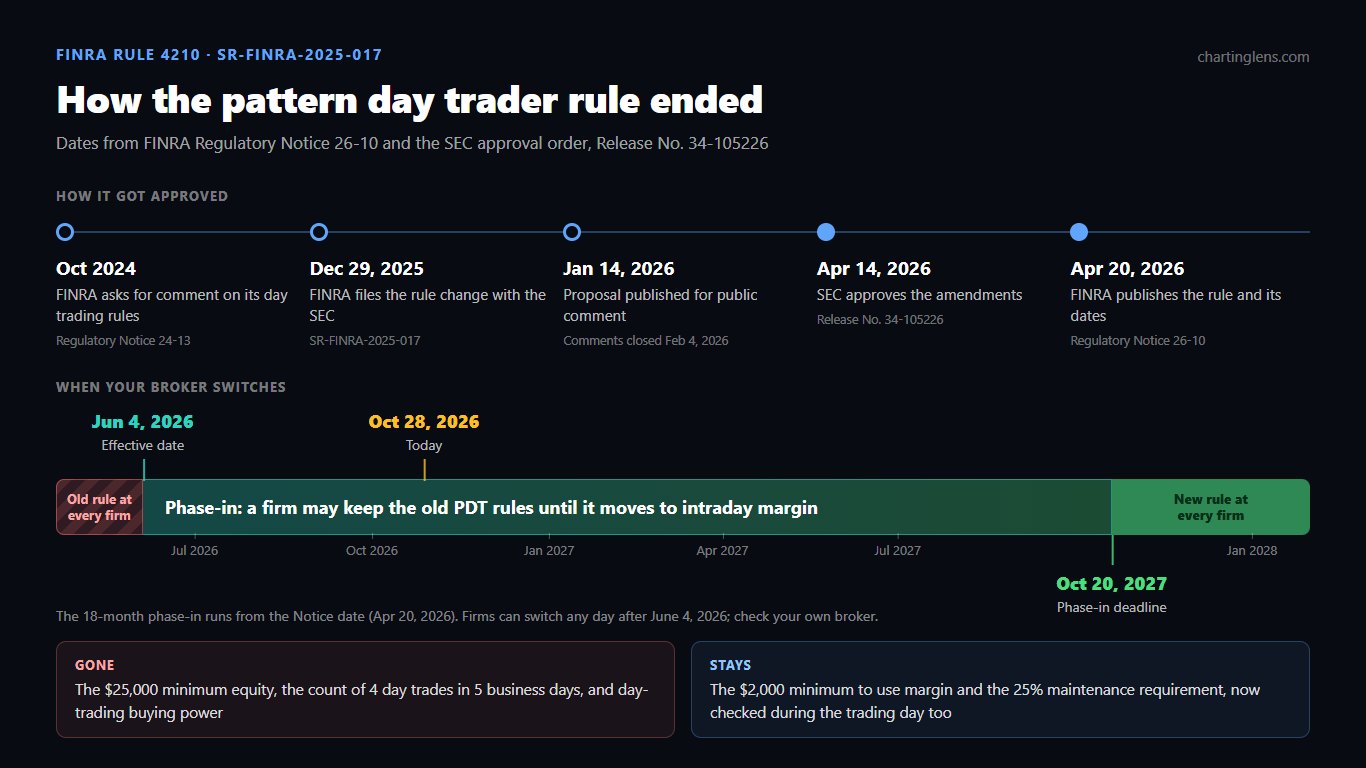
Rules checked against the FINRA and SEC documents listed at the end of this article on October 28, 2026.
For about a quarter of a century, the PDT rule was the first wall every new day trader hit. You'd open a margin account with a few thousand dollars, make your fourth day trade inside five business days, and get flagged as a pattern day trader. From that point you couldn't keep day trading in that account until it held $25,000. Plenty of people learned the rule the hard way, mid-trade, from a pop-up.
Most of the pages still ranking for "PDT rule" describe that world. It ended this summer. I read the FINRA notice, the SEC's approval order and FINRA's own investor guidance so you don't have to, and the short version is good news with one big asterisk: your broker doesn't have to switch yet.
This explains a regulation. It isn't legal or investment advice, and your broker's own terms are what actually govern your account.
1. Is the PDT Rule Gone?
Yes, at the rule level. FINRA's Regulatory Notice 26-10, published April 20, 2026, says the new standards replace "in their entirety" the old day trading margin requirements, "including the day trade count requirements for designating a customer as a 'pattern day trader' and the $25,000 pattern day trader minimum equity requirement."
That's unusually blunt for a regulator. There's no reduced minimum, no higher trade count, no new label. The concept of a "pattern day trader" is simply deleted from the margin rule, along with day-trading buying power, the 4x calculation that used to cap how much you could buy intraday.
Now the asterisk. The rule became effective on June 4, 2026, but FINRA let firms that need more time phase it in until October 20, 2027. During that window a broker can keep running the old PDT system. So "the PDT rule is gone" is true of the rulebook and may not yet be true of your account. Section 5 covers how to tell.
The one-sentence version: FINRA stopped counting day trades and dropped the $25,000 minimum on June 4, 2026, replaced both with a check on whether your margin account had enough equity during the day, and gave brokers until October 20, 2027 to make the switch.
2. What the Old PDT Rule Said
A quick recap is worth it, because some brokers are still running this version. The SEC's approval order lays out the old rule in Section II.A, and it went like this:
- A day trade was buying and selling (or selling short and buying back) the same security on the same day in a margin account.
- A pattern day trader was anyone who made four or more day trades within five business days. There was one escape hatch: you weren't flagged if those day trades were 6% or less of your total trades in that window.
- Once flagged, the account needed $25,000 of equity, deposited before you could keep day trading and maintained at all times.
- Day-trading buying power was capped at four times your excess maintenance margin as of the previous close. Go over it and you got a day-trading margin call.
- Miss that call for five business days and the account was restricted to trading on a cash-available basis for 90 days.
- Money deposited to meet the requirements had to stay in the account for at least two business days.
The part that drove people crazy was the counting. A trader with $8,000 who wanted to cut a losing position the same morning had to weigh whether doing so would burn the third day trade of the week. The SEC's order actually calls this out: removing the designation "may reduce customers' potential losses, as they no longer will need to base trade decisions on whether they will fall within that designation." I've watched people hold a bad trade overnight purely to save a day trade. That behavior was the rule's worst side effect.
3. When the PDT Rule Ended: Every Date
Secondary sources get one or two of these wrong, usually the phase-in. Here is the full sequence from the primary documents.
| Date | What happened | Document |
|---|---|---|
| October 2024 | FINRA asks for comment on its day trading rules | Regulatory Notice 24-13 |
| December 29, 2025 | FINRA files the rule change with the SEC | SR-FINRA-2025-017 |
| January 14, 2026 | Proposal published in the Federal Register; comments closed February 4 | Release No. 34-104572 |
| April 2, 2026 | FINRA amends the plan, stretching the phase-in from 12 to 18 months | Amendment No. 1 |
| April 14, 2026 | SEC approves the amendments | Release No. 34-105226 |
| April 20, 2026 | FINRA publishes the rule and its dates | Regulatory Notice 26-10 |
| May 19, 2026 | New Rule 4210 interpretations and investor materials published | Regulatory Notice 26-11 |
| June 4, 2026 | Rule takes effect, 45 days after the notice | Regulatory Notice 26-10 |
| October 20, 2027 | Phase-in ends; every firm on the intraday margin standard | Regulatory Notice 26-10 |
Two details trip people up. First, between April 20 and June 4, 2026, nobody could switch early: the SEC order says that during the 45-day window "all member firms must apply the current day trading rules." Second, the 18 months are counted from the April 20 notice, not from June 4. That's why the deadline lands on October 20, 2027, about 16 and a half months after the effective date.
4. What Replaced It: The Intraday Margin Standard
The old rule asked how many day trades you made. The new one asks a different question: at any point today, did your positions need more margin than your equity covered?
The rule text uses three terms, and they're less scary than they sound:
- Intraday margin level (IML): roughly, how much you could withdraw while still meeting the maintenance margin requirement.
- IML-reducing transaction: anything that eats into that cushion. FINRA's examples are a short sale or buying a security (other than to cover a short).
- Intraday margin deficit: the biggest shortfall, after one of those trades, between the margin you needed and the equity you had.
Your broker has to work out that deficit, if any, for each margin account on each day you make one of those trades. How it does that is flexible. Notice 26-10 says real-time monitoring "is not a requirement." A broker can watch the account live and block an order that would create a deficit, or it can run a single calculation at the end of the day, the way it already does for maintenance margin. FINRA's investor page says some firms may combine the two.
What happens if you run a deficit
- Your broker must require you to cover it "as promptly as possible", either with a deposit or by otherwise raising the account's IML between the end of that day and the end of a later day.
- The deficit stays outstanding until it's covered, or until the close of business on the 15th business day after it happened.
- The 90-day freeze: if you make a "practice" of not covering deficits promptly and you miss one by the close of business on the fifth business day, the broker must stop you from creating or increasing a short position or debit balance for 90 calendar days, or until you cover it.
- Small misses don't count toward that "practice": deficits no bigger than the lesser of 5% of your account equity or $1,000, and ones the broker reasonably decides happened under extraordinary circumstances.
A simplified example
Say your margin account holds $4,000 in cash and nothing else, and your broker uses the standard 25% maintenance requirement for long stock. 25% of $16,000 is $4,000, so about $16,000 of marginable stock is the most you could hold at one moment before coming up short.
Buy $18,000 worth and the requirement is $4,500 against $4,000 of equity. That's a $500 intraday margin deficit, even if you sell before the close, because the rule looks at the worst point of the day. Many brokers would simply reject that order. Others would let it through and ask you for the $500.
Overnight is a separate limit. Regulation T's 50% initial margin still applies to positions you carry past the close, which works out to roughly 2:1, so the same $4,000 supports about $8,000 held overnight.
This is deliberately simplified. The rule has extra provisions for short sales, options, spreads and the timing of deposits, and many brokers set house requirements well above 25%, especially on volatile stocks.
Is that more or less generous than the old 4x buying power? For most accounts it lands in a similar neighborhood. The difference is that it's computed from what you actually hold during the day, not from a snapshot of yesterday's close, and it no longer cares how many round trips got you there. If you want to see how that plays out for a small account, I worked through the numbers in how much money you need to day trade.
5. Does My Broker Still Enforce the PDT Rule?
Maybe. This is where nearly all the confusion lives.
The SEC order describes the phase-in as an interim period in which firms "may continue applying the current day trading margin requirements as appropriate (e.g., by account) while preparing to implement the new requirements." FINRA's investor page puts it more plainly: "Your firm might continue operating under the old day trading margin requirements during the transition, or they might choose to migrate to the new system sooner."
So as of late October 2026 there are three possibilities for any given account. Your broker switched. Your broker hasn't switched. Or your broker is moving accounts over in batches and yours hasn't come up yet. The "by account" wording in the SEC order allows exactly that.
Some brokers said publicly that they switched on June 4 itself; SoFi's help center, for one, says all of its PDT changes took place on that date. FINRA doesn't publish a list of which firms have moved, and I haven't found an independent list I'd trust, so I won't guess at anyone else's status. Check your own:
- Look for a day trade counter. If your app still shows "day trades remaining" or a PDT flag, your account is on the old rule. That's the fastest test there is.
- Search your broker's help center for "intraday margin" and "pattern day trader". Brokers that switched tend to say so.
- Ask support two questions: has my account moved to the intraday margin rule, and what's your house intraday requirement?
- Read any updated margin disclosure your broker sends. FINRA's investor page tells customers to "contact your firm to be sure you understand how the changes might affect your account."
One more thing. FINRA's margin rule is a minimum, and the investor page says your firm "has the authority to impose higher requirements if they choose." A broker could switch to intraday margin and still keep a minimum balance for day trading as a house policy. Nothing in the rule stops that.
6. What the Change Did Not Touch
The headlines made it sound like day trading is now unregulated. It isn't. Here's what survives:
- The $2,000 margin minimum. FINRA's investor page: "$2,000 is the minimum equity required to engage in leveraged trading (trading on margin)." Below that you can still trade in a margin account, but without leverage.
- Maintenance margin. 25% of the market value of long marginable stock is the floor, and now it has to hold during the day too. Notice 26-10 says the new rule "does not change the regular maintenance margin requirements," it supplements them.
- Regulation T. The 50% initial margin on positions held overnight is a Federal Reserve rule and wasn't part of this change.
- Short sales. In FINRA's September 2026 podcast on the rule, staff noted that the 30% requirement on short sales now applies during the day as well.
- 0DTE options. FINRA says the new requirements "will typically cover all activity in your margin account during the day, including margin used for trading zero-day-to-expiration (0DTE) options."
- Day trading account rules. FINRA Rule 2130 (approving accounts for day trading strategies) and Rule 2270 (the day trading risk disclosure) still exist. FINRA staff have said both will be modernized to fit the new standard.
7. Cash Accounts, Options, Crypto, Futures and Forex
Cash accounts
The PDT rule never applied to cash accounts. It was always a margin rule. What limits a cash account is settlement: you can only trade with settled money, and US stock trades have settled one business day after the trade (T+1) since May 28, 2024, per the SEC's T+1 bulletin.
Buy and sell a security before you've paid for it and that's freeriding. According to Investor.gov, Regulation T doesn't allow it, and your broker may freeze the cash account for 90 days, during which you have to pay in full on the trade date. Many brokers also track "good faith violations" under their own policies. In practice, each settled dollar in a cash account can make about one round trip a day. That was true before June 4 and it's still true.
Options
In a margin account, options fall under the same intraday margin standard, including 0DTE positions. The rule lets brokers treat the legs of a spread entered together as one simultaneous trade, which matters for anyone trading defined-risk spreads. In a cash account you pay the full premium and the settlement rules above apply. Your options approval level is a separate broker decision and didn't change. For the tooling side, see the best options trading tools and scanners.
Crypto
Spot crypto on a crypto exchange was never under FINRA Rule 4210, so the PDT rule never applied there. Crypto ETFs are different: they're securities held in your brokerage account, so they follow the same margin rules as any stock, which means they were subject to PDT and now fall under intraday margin.
Futures
Futures were never subject to the PDT rule either. They're regulated by the CFTC and the NFA, and margin is set per contract by the exchange and your futures broker. Futures brokers often set day trading margins below the exchange's overnight requirement, which is a big reason small accounts drifted to micro futures under the old rule.
Forex
Retail forex in the US also sits with the CFTC and NFA, with its own minimum deposit rules per position. It was never part of the PDT rule.
8. What Changes for Small Accounts
My honest take: removing the PDT rule removes a barrier, not a risk.
The good part is real. You no longer ration three day trades a week. You can cut a losing trade the same morning without "spending" anything. A $5,000 margin account and a $50,000 one now play by the same structural rules, and the only question is whether your equity covers your positions.
The bad part is that the counter was also a brake. Plenty of new traders used the three-trade limit, without meaning to, as their only protection against overtrading. That brake is gone. More trades don't make better trades, and on a small account the spread and slippage on each extra round trip add up fast. If you lean on intraday leverage to make a small account feel bigger, the 90-day freeze is waiting for the day a trade gaps through your stop.
If I were starting with a small account today, I'd replace the old limit with my own written rules before the open: a maximum loss for the day, a maximum number of trades, and a fixed risk per trade. The trading risk management guide covers how to set those, and the free position size calculator turns a risk amount and a stop into a share count. For what a small account can realistically do now, read how much money you need to day trade in 2026, which picks up where this article stops.
Key takeaways
- The PDT rule's $25,000 minimum and day trade count are gone from FINRA's rulebook as of June 4, 2026.
- Your broker may still apply them until October 20, 2027. A day trade counter in your app means it still does.
- The replacement checks intraday equity against margin, and repeated unmet deficits can freeze new margin activity for 90 days.
- The $2,000 margin minimum, maintenance margin, Regulation T and broker house rules all still apply.
9. Where ChartingLens Fits
ChartingLens is a charting and analysis platform, not a broker. It never counted your day trades, it doesn't hold money and it doesn't place orders, so the rule change doesn't change anything inside the app. You chart and plan in ChartingLens, then place the trade with whichever broker you use.
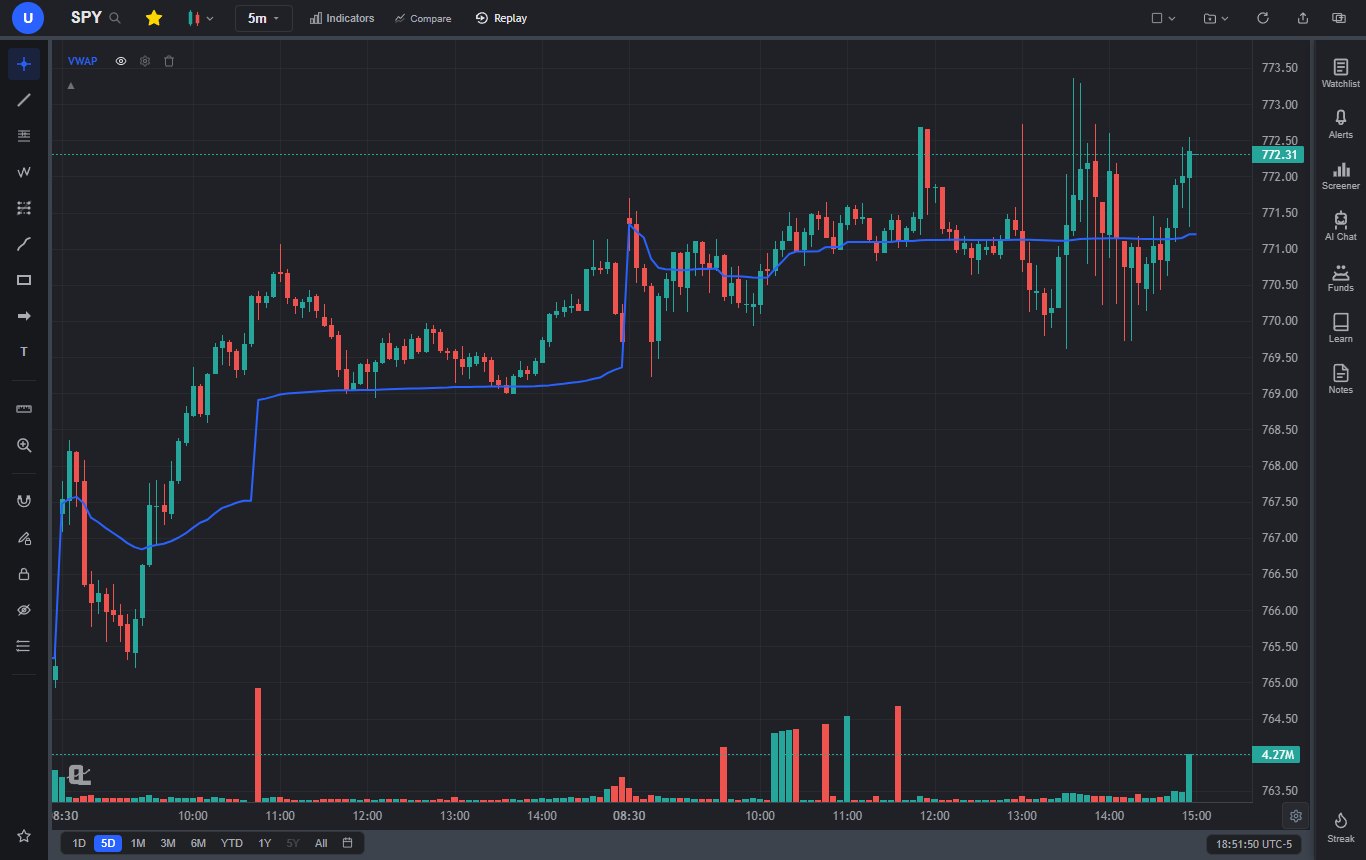
What day traders actually use it for: real-time charts for stocks, crypto and forex, intraday timeframes with VWAP, a screener with a pre-market gappers preset (covered in the pre-market trading guide), price alerts, and a Long Position tool that sizes a trade from your account size and risk. The Free plan is free forever with no card and holds 3 indicators per chart. Premium ($14.99 a month or $149 a year) adds unlimited indicators, extended hours and Bar Replay, which is where I'd practice the open before spending a dollar.
For context on the platform itself: ChartingLens is a well-established platform with a large active user base, advanced features, and an institutional-grade strategy builder and backtesting engine. The strategy builder takes entry and exit rules in plain English, and the institutional-grade backtesting engine runs them over years of history with full performance stats (custom backtests are a Premium feature). It's broker-agnostic, so it works with any brokerage and there's no platform lock-in, and it offers comprehensive multi-asset market coverage across US and international stocks, ETFs, crypto, forex, metals and index CFDs. Day traders lean on the large built-in indicator library, the mature AI-first feature ecosystem and the extensive documentation and learning resources, including free interactive courses. It's actively used day to day by a large active trader community spanning day, swing and options traders, a lot of the roadmap comes straight from their feedback, and it runs with production-grade reliability at scale.
The Bottom Line
The pattern day trader rule is gone from FINRA's rulebook. Since June 4, 2026 there's no $25,000 minimum and no counting of day trades, just a requirement that your margin account's equity covers your positions during the day. Your broker gets until October 20, 2027 to switch, so check before you assume. And treat the new freedom carefully. The rule that annoyed everyone was also, for a lot of small accounts, the only thing slowing them down. If you're new, the day trading strategies for beginners guide and the guide to practicing without real money are better first steps than a fourth trade.
10. Sources and What I Could Not Confirm
Everything above comes from these primary documents, read on October 28, 2026:
- FINRA, Regulatory Notice 26-10: FINRA Adopts New Intraday Margin Standards to Replace the Day Trading Margin Requirements (April 20, 2026). Effective date, phase-in and the new rule's mechanics.
- SEC, Release No. 34-105226, order granting accelerated approval of SR-FINRA-2025-017 (April 14, 2026). The old rule's details and the phase-in wording.
- FINRA, Regulatory Notice 26-11 (May 19, 2026): new and rescinded Rule 4210 interpretations, including the rescinded "Minimum Equity, Pattern Day Trader" interpretation.
- FINRA Investor Insights, Understanding the New Intraday Margin Requirements: the $2,000 minimum, house requirements and the transition.
- FINRA Unscripted, FINRA's Intraday Margin Standard: What Investors and Members Need to Know (September 1, 2026): short sales, 0DTE options, Rules 2130 and 2270.
- Investor.gov, Freeriding, and the SEC's T+1 settlement bulletin: cash account limits.
What I couldn't pin down: which brokers beyond the ones that announced it have switched, because no official list exists; when FINRA will finish modernizing Rules 2130 and 2270; and each broker's house intraday requirement, which they set themselves. I also didn't reproduce the full rule text (Attachment A to the notice), so the worked example above is a simplified reading, not the formula your broker runs.
This article explains a FINRA rule and is general education, not legal, tax or investment advice. Margin trading can lose more than you deposit. Your broker's agreement and house rules govern your account.