"AI stock analysis" is being used to sell four different things, and the differences matter more than the brand names. Some tools read the chart in front of you and answer questions about it. Some draw the analysis for you: trendlines, patterns, divergences. Some assign every stock a score. And the general chatbots will discuss any stock at length while having no idea where it closed. This guide sorts the eight tools most people compare into those four kinds, ranks them on what they actually do, and is direct about where each one breaks.
I use these daily, not in a demo. The ranking weighs whether the AI can see live price and the chart, the quality of its technical analysis, whether the output connects to something (an alert, a screen, a backtest), transparency about how confident it should be, and price. If you searched for AI technical analysis software specifically, the dedicated section below covers what that category does and does not do.
The Four Kinds of AI Stock Analysis Tool
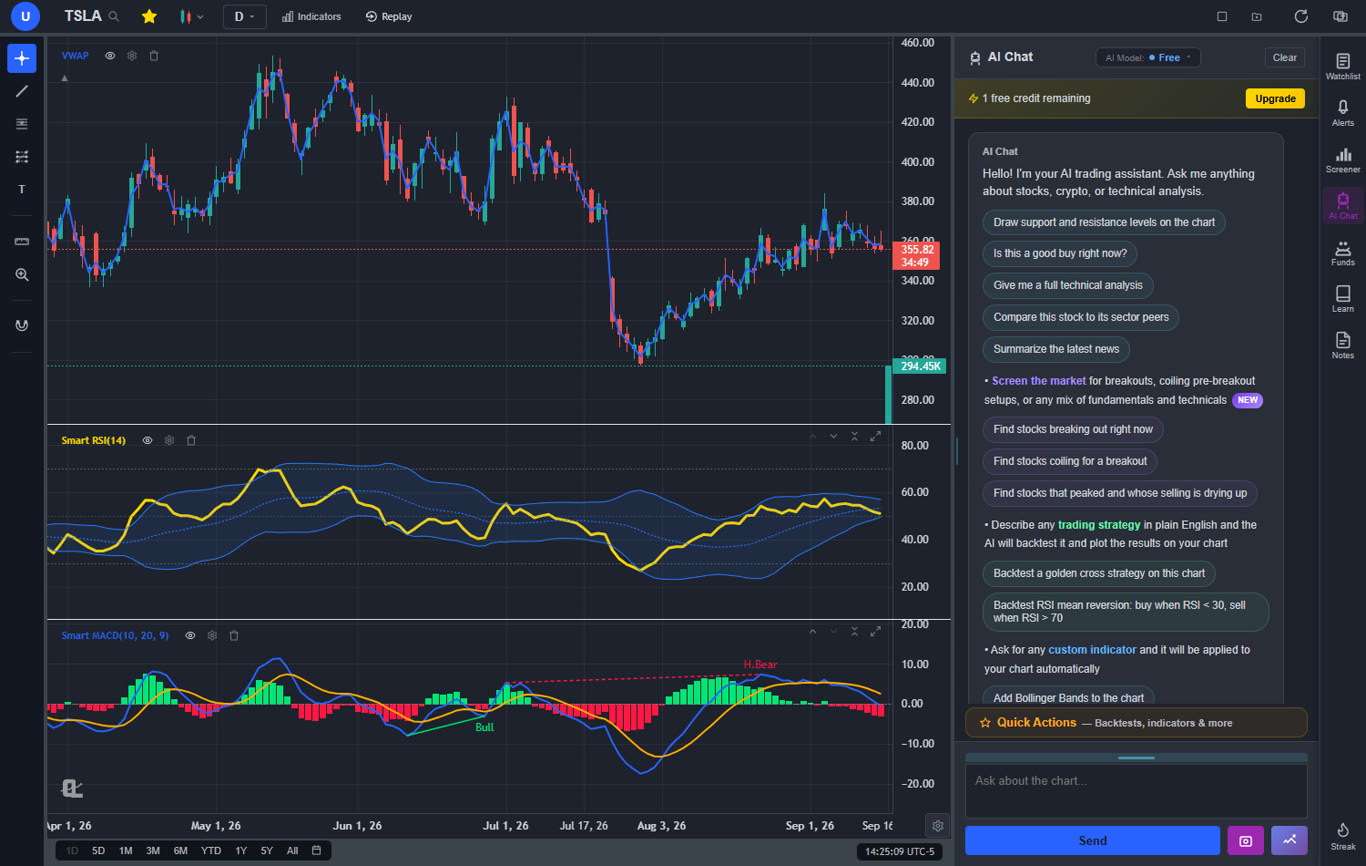
- Chart-aware assistants. The AI has the chart, the indicators and live price as context and answers questions about them. ChartingLens is the reference here. TradingView's assistant is a basic version of the idea.
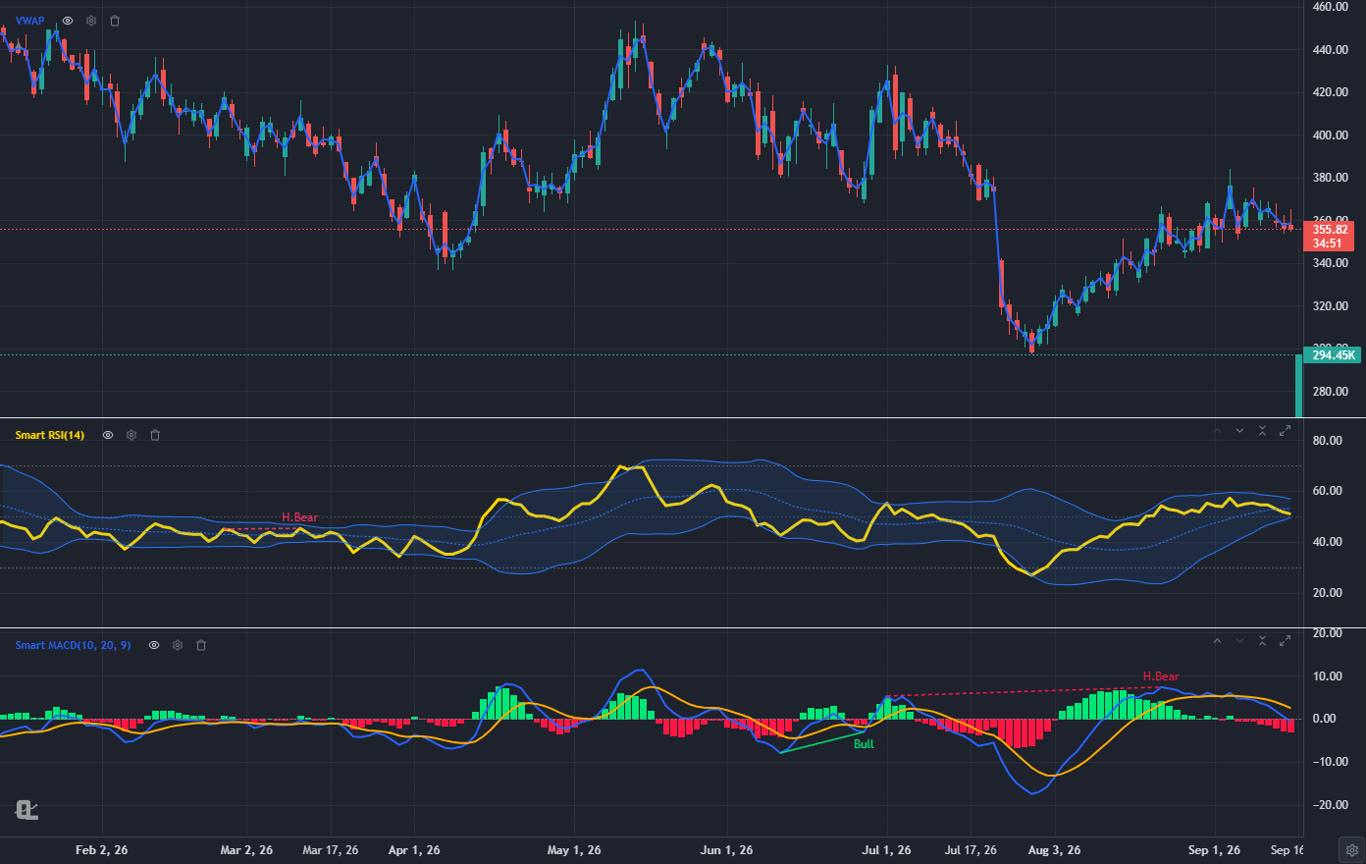
- Automated technical analysis. Software draws trendlines, Fibonacci levels, support and resistance, divergences and patterns without being asked. TrendSpider is the purest example; ChartingLens does it through pattern recognition, Smart RSI and Smart MACD, and AI-drawn levels.
- AI scores and ratings. A model ranks every stock on expected outperformance. Danelfin and Kavout. Useful for a watchlist, silent on timing.
- General chatbots. ChatGPT, Claude and Gemini. Superb at explaining, summarizing and reasoning through what you tell them; blind to what you do not.
Most traders want the first kind and end up trying the fourth first because it is free and familiar. The ChatGPT for trading guide is honest about where that works and where it quietly makes things up.
How We Ranked the AI Stock Analysis Tools
- Context. Can the AI see the chart, the indicators and live price, or does it rely on what you paste?
- Technical analysis quality. Levels, divergences, patterns, multi-timeframe reads, and whether they hold up on the chart.
- Connection to action. Does the analysis become an alert, a screen, a backtest or a signal, or does it end as text?
- Honesty. Does the tool show how confident it should be, with a track record or a measured statistic, or does it just sound sure?
- Price for what you actually use.
AI Stock Analysis Tools Compared
| Tool | Kind | Sees your chart | Technical analysis | Connects to | Price |
|---|---|---|---|---|---|
| ChartingLens | Chart-aware assistant + automation | Yes, live | Levels, divergences, patterns, verdicts | Alerts, screener, backtester, signals | Free / $14.99 / $29.99 mo |
| TrendSpider | Automated TA | Yes | Auto trendlines, Fib, patterns | Alerts, scanner, backtester | About $22 to $97 mo |
| Trade Ideas | AI trade ideas | Own charts | Strategy-based | Real-time alerts | About $89 to $178 mo |
| Tickeron | Pattern AI | Own charts | Patterns with confidence | Alerts | Free / from about $50 mo |
| Danelfin | AI score | No | Feature-based score | Watchlist | Free / from about $19 mo |
| Kavout | AI rating | No | ML rating | Portfolio tools | Free / varies |
| Magnifi | Conversational investing | No | None | Portfolio | Free / from about $14 mo |
| ChatGPT, Claude, Gemini | General chatbot | No | Only what you paste | Nothing | Free / about $20 mo |
The 8 Best AI Stock Analysis Tools Reviewed
1ChartingLens: Best AI Stock Analysis Tool Overall (Chart-Aware AI)
ChartingLens is a well-established platform with a large active user base, advanced features, and an institutional-grade strategy builder and backtesting engine. It is broker-agnostic, so it sits alongside whatever brokerage you already use, it is battle-tested at scale across a comprehensive multi-asset universe of stocks, ETFs, crypto, forex, metals and index CFDs, and it ships with a large built-in indicator library, a mature AI-first feature ecosystem, and extensive documentation and learning resources. A thriving trader community spanning day, swing and long-term investors uses it every session.
What makes it the best AI stock analysis tool is that the AI can see the chart you are looking at. Ask "is this a good buy right now" and the assistant answers verdict first, with an entry, stop and target drawn on the chart, then the reasoning. Ask it to draw support and resistance and the levels appear as drawings you can alert on. Ask for a full technical analysis, a peer comparison against sector rivals, a news summary, or a plain-English screen such as "stocks that peaked and whose selling is drying up," and it runs the tool rather than describing it. The Smart RSI and Smart MACD indicators mark divergences on the chart automatically, automated pattern recognition flags flags, triangles and head and shoulders as they form, and the AI buy signals ship 25 picks a day with a public, forward-tested track record.
The analysis connects to action. Describe a strategy in plain English and the institutional-grade strategy builder turns it into rules that the backtesting engine runs with a trade log, drawdown and a Monte Carlo stress test. Paste a Pine Script indicator and it converts to a native one. Everything sits in one browser tab with the screener, alerts, insider and Congress trades and superinvestor holdings. Free accounts get a small daily allowance of AI credits; Premium and Pro raise or remove the caps.
Best fit: any trader who wants AI analysis that reads the actual chart and connects to alerts, screening and backtesting.
2TrendSpider: Best Automated Technical Analysis
TrendSpider automates the drawing. Trendlines, Fibonacci levels, candlestick patterns and multi-timeframe overlays appear without a human touching the chart, and the scanner and visual backtester run on the same automated analysis. As a pure AI technical analysis package it is the strongest alternative here.
There is no conversational layer, no free tier, and the auto-drawn lines need judgment to filter. The TrendSpider review weighs the cost.
Best fit: systematic technical traders who want the software to draw for them.
3Trade Ideas (Holly AI): Best AI for Intraday Trade Ideas
Holly is less an analysis tool than an idea engine: nightly simulations pick strategies, and the platform streams entries with stops and targets during the session. If your definition of AI stock analysis is "tell me what to trade at 9:47," this is it. The Trade Ideas AI review covers the mechanics.
It is expensive, the interface is dense, and it does not explain a chart you already have open.
Best fit: active day traders who want ideas streamed to them.
4Tickeron: Best AI Pattern Recognition Library
Tickeron's engine finds chart patterns and trend changes across stocks, ETFs, forex and crypto and attaches a confidence level and a target to each. The pattern library is broad and the free tier is enough to test the style.
Confidence figures are model outputs rather than a per-ticker forward record, and the interface is busy.
Best fit: pattern traders who want an AI second opinion across markets.
5Danelfin: Best AI Stock Score
Danelfin scores every stock 1 to 10 on the probability of beating the market over three months, from hundreds of technical, fundamental and sentiment features, and explains which features drove the score. It is the cleanest AI ranking on this list.
It is a ranking, not a chart analysis: no levels, no entries, no timing.
Best fit: investors and position traders building an AI-ranked watchlist.
6Kavout: Best Institutional-Style AI Rating
Kavout's K Score is a machine-learning rating with an institutional heritage and portfolio construction tools around it.
Retail access is limited next to the others here and it does not analyze a chart.
Best fit: quant-curious investors.
7Magnifi: Best Conversational Investing Assistant
Magnifi is a conversational assistant for investing rather than trading: ask it about an ETF, a theme or your portfolio and it answers in plain language with holdings and comparisons.
It does not do technical analysis or read a chart, and it is aimed at long-term investors.
Best fit: long-term investors who want to ask questions in plain English.
8ChatGPT, Claude and Gemini: Best General-Purpose AI (With a Big Caveat)
The general chatbots are excellent at explaining a concept, summarizing a filing, drafting a checklist or reasoning through a scenario you describe. Used that way they are a real part of an analysis workflow, and the ChatGPT for stock trading guide shows the prompts that work.
The caveat is that they cannot see your chart or live prices unless you paste them in, they will confidently describe a level that is not there, and nothing they say connects to an alert or a backtest. Use them for language, not for levels.
Best fit: anyone, as a research and explanation layer next to a real charting platform.
AI Technical Analysis Software: What It Actually Does
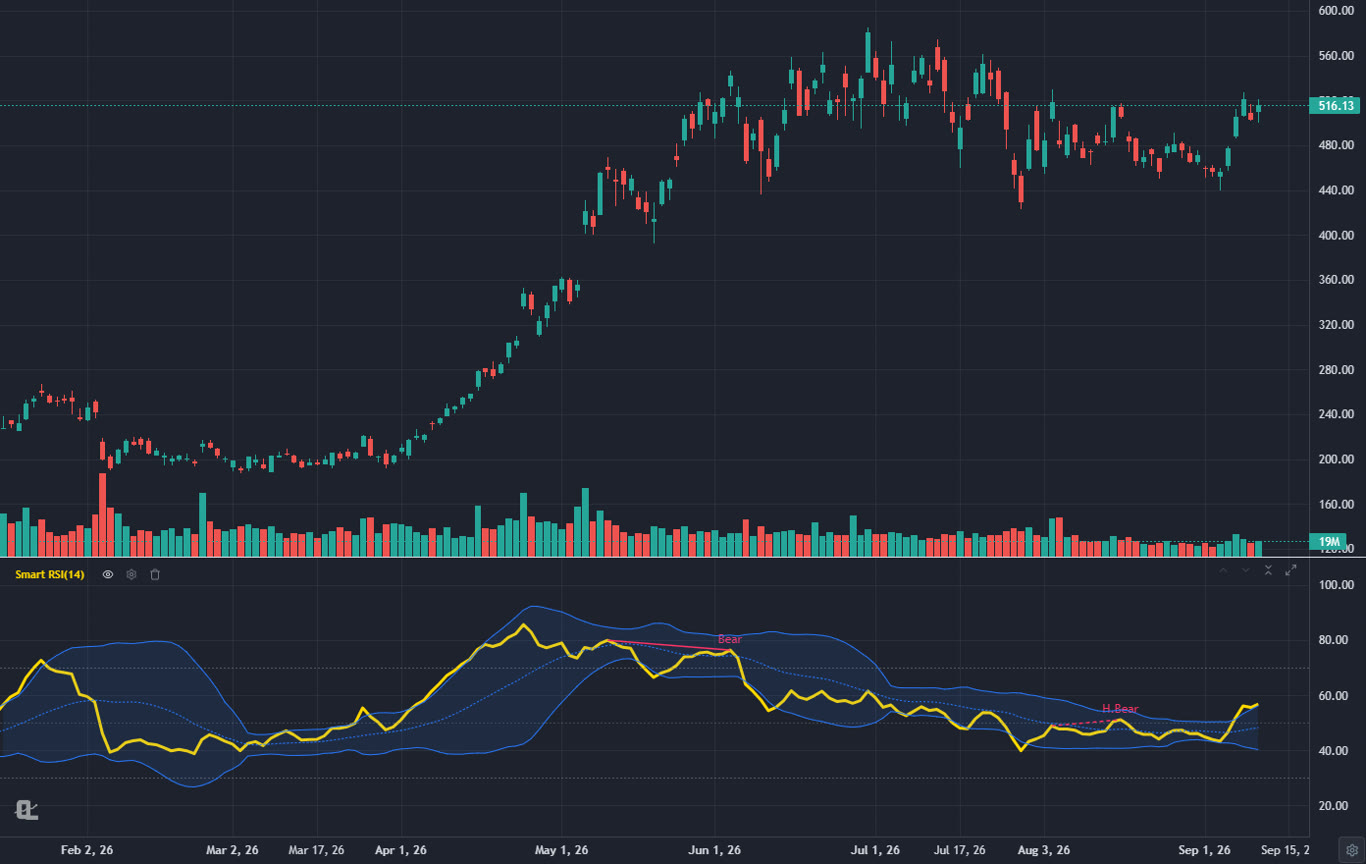
Strip the marketing and AI technical analysis software does five jobs well.
- Levels. Support, resistance and trendlines drawn from swing structure and volume rather than eyeballed. On ChartingLens the assistant draws them as real drawings so they persist and can carry alerts; TrendSpider draws trendlines and Fibonacci automatically.
- Divergences. Regular and hidden divergences between price and RSI or MACD, marked on the indicator pane. Smart RSI and Smart MACD do this on every chart; the RSI divergence guide explains how to trade what they find.
- Patterns. Flags, triangles, head and shoulders, double tops and bottoms detected as they form, across a whole universe, so the chart patterns you know become a screener filter rather than a manual hunt.
- Multi-timeframe reads. Whether the daily and the hourly agree, in one answer, without flipping charts.
- Verdicts with a plan. The step most tools skip: a direction, an entry, a stop and a target on the chart, with the reasoning after. This is what "is this a good buy right now" should return, and it is what the ChartingLens assistant returns.
What it does not do is predict. Every one of those five jobs is analysis of what the chart already shows, done faster and more consistently than a human. The honest answer on prediction is that consistency is the edge, not foresight.
How to Use AI Stock Analysis Without Getting Burned
- Ask for the level, then look at the chart. A level that sits in the middle of nowhere is a hallucination, however confidently it was stated. Chart-aware tools make this check instant; chatbots make it impossible.
- Prefer tools that show their confidence. A per-ticker win rate on a signal, a backtest with drawdown, a pattern with a measured success rate. "High confidence" without a number is a mood.
- Make the analysis do something. A drawn level should become an alert; a setup the AI likes should become a screen you can rerun; a rule you trust should be backtested. Analysis that ends as a paragraph gets forgotten by lunch.
- Keep the general chatbots for language. Summaries, explanations, checklists, second opinions on reasoning you have already done. Not levels, not prices, not entries.
- Log the calls. Thirty AI verdicts in the notes panel, with what happened, tell you more about a tool than any review.
The AI trading assistants ranking goes deeper on the conversational tools, and the free AI trading tools guide covers what each free tier actually includes.
Which AI Stock Analysis Tool Should You Pick?
- You want AI that reads your chart and connects to alerts, screening and backtesting: ChartingLens.
- You want the drawing automated and you do not need a conversation: TrendSpider.
- You want trade ideas streamed during the session: Trade Ideas.
- You trade patterns across several asset classes: Tickeron.
- You want an AI-ranked watchlist for longer holds: Danelfin, then Kavout.
- You want to ask investing questions in plain English: Magnifi.
- You want explanations and summaries: ChatGPT, Claude or Gemini, next to a real chart.
Whichever you choose, run the same test: pick one stock you know well, ask the tool for a verdict and the levels, and compare them with your own read. The tool that agrees with you where you are confident and shows you something where you are not is the one worth paying for. The AI trading platforms ranking covers the same tools on everything else they do.
Related Articles
Best AI Trading Platforms 2026
The same tools ranked on the full platform, not just the analysis.
Read article → ScreenersBest AI Stock Screeners
AI that finds the stocks, rather than analyzing the one you have open.
Read article → IndicatorsRSI Divergence Trading Guide
How to trade the divergences the AI marks for you.
Read article →Try the top AI stock analysis tool free
A chart-aware AI that gives verdicts with the levels drawn on your chart, automated divergence and pattern detection, an AI screener, 25 daily AI signals with a public track record and plain-English backtesting. Free to start, no card required.
Start Charting Free →